Recorded on December 8, 2021, this video features a series of talks by members of the UC Berkeley Department of Psychology, in celebration of the department’s 100th anniversary. Speakers included:
- Raka Ray, Dean, UC Berkeley Division of Social Sciences
- Rhona Weinstein, Professor Emeritus, Department of Psychology
- Silvia Bunge, Professor, Department of Psychology & Helen Wills Neuroscience Institute | Director, Building Blocks of Cognition Lab
- Allison Harvey, Professor, Department of Psychology | Director, Golden Bear Sleep and Mood Research Clinic
- Rich Ivry, Professor, Department of Psychology | Director, Cognition and Action Lab
- Rodolfo Mendoza Denton, Professor, Department of Psychology | Co-Director, Relationships and Social Cognition Lab
- Monica Ellwood-Lowe, Ph.D. student
- Hari Srinivisan, Undergraduate Class of 2022
The event also featured a video featuring members of the Charter Hill Society for Psychology, a community of committed donors who make a three-year pledge of $1,000 or more per year to the Psychology Annual Fund.
Lightning Talks
The event featured “lightning talks,” short form-presentations from four distinguished members of the faculty, showcasing the exciting research being conducted in this top-ranked department. Following are abstracts and bios for the faculty members who presented the four lightning talks.
(How) does education change minds and brains?
Silvia Bunge, Professor, Department of Psychology & Helen Wills Neuroscience Institute | Director, Building Blocks of Cognition Lab
A disconcerting fact is that many of the details that we memorize in our classes fade away in the months or years after we complete our final exams, and it is likely that we will only leverage a small portion of it as we move forward in our careers. An important question, then, is: what, if anything, remains? Does education change us fundamentally – and, if so, how? My lab is interested in whether and how formal education hones our ability to reason logically. I will describe how my lab has approached this problem in the past through behavioral and brain imaging research. I will then mention a topic I am passionate about pursuing in the future: how ideological beliefs bias reasoning, and whether/how education can combat this pervasive societal problem.
 Dr. Silvia Bunge is a Professor in the Department of Psychology and the Helen Wills Neuroscience Institute at the University of California, Berkeley. Her research draws from the fields of cognitive neuroscience, developmental psychology, and education research. She studies the cognitive and neural processes that support reasoning, memory, and goal-directed behavior in humans. Her lab also studies how these processes mature over childhood and adolescence, how they are shaped by education and demographic factors (for better and for worse) and how they support academic achievement. Dr. Bunge is the co-author of a forthcoming textbook titled “Fundamentals of Developmental Cognitive Neuroscience”.
Mental Health and Sleep Health: Challenges Ahead
Allison Harvey, Professor, Department of Psychology | Director, Golden Bear Sleep and Mood Research Clinic
Mental health challenges are common and are often chronic and difficult to treat. My team is interested in treating sleep and circadian problems as a pathway to improving mental health. As we work in this arena, we have become passionate about several challenges that impede progress, such as: How do we ensure scientific breakthroughs reach real-world practice? How do we move beyond diagnostic categories to study mental health challenges as complex, heterogeneous and multi-dimensional phenomena? How can we improve access to effective treatment? Once a person accesses treatment, how do we ensure the treatment promotes lasting change? I will describe how we can leverage implementation science and the science of behavior change to develop solutions to these pressing challenges.
 Allison Harvey is a Professor and licensed Clinical Psychologist. Dr. Harvey is a treatment development researcher who conducts experimental and intervention studies focused on understanding and treating sleep and circadian problems, severe mental illness and behavior change processes. Dr. Harvey is a recipient of numerous awards including the Lifetime Achievement Award from the Sleep Research Society in 2020. She has also been awarded an Honorary Doctorate from the University of Orebro, Sweden and is a Fellow of the Association for Psychological Science.
Mining the secrets of the human brain
Rich Ivry, Professor, Department of Psychology | Director, Cognition and Action Lab
Cognitive neuroscientists seek to understand the biology of the mind. The development of new methods to probe and perturb the human has helped establish this interdisciplinary enterprise as an essential cornerstone of psychological research. I will review a sample of these technologies, describing how they have been exploited by researchers in our department to develop sophisticated models of the neural basis of human cognition and how these advances in basic research are leading to the development of new interventions in the treatment of neurological and psychiatric disorders.
 Rich Ivry is a professor of psychology and neuroscience at the University of California, Berkeley. He directs the Cognition and Action lab, using various tools of cognitive neuroscience to explore human performance in healthy and neurologically impaired populations. He is the co-author of the textbook, Cognitive Neuroscience: The Biology of the Mind.
Psychological factors affecting equity in higher education
Rodolfo Mendoza Denton, Professor, Department of Psychology | Co-Director, Relationships and Social Cognition Lab
Despite decades of research, disparities in educational outcomes between majority and minority group students persist at all levels of education. Particularly perplexing is the persistence of these inequalities at the highest levels of training, which already selects for the most highly achieving students for specialization in their field of study. This talk will cover some of the psychological processes that can explain these inequalities, and discuss how the structure of traditional higher education may contribute to these disparities.
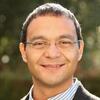 Rodolfo Mendoza-Denton is professor of psychology at the University of California, Berkeley. Childhood experiences living in Mexico, the U.S., Ivory Coast, and Thailand cemented an early interest in cultural differences and intergroup relations. He received his BA from Yale University and his PhD from Columbia University. Mendoza-Denton’s professional work covers stereotyping and prejudice from the perspective of both target and perceiver, intergroup relations, as well as how these processes influence educational outcomes. He received the UC Berkeley Chancellor’s Award for Advancing Institutional Excellence in 2015, and the University-wide Distinguished Teaching Award in 2018.




 Kevin P. Donovan
 Lana Swartz


 Bruce Riordan
 Daniel J. Sargent
 Martha WIlfahrt
 Scott Straus
 Alberto Díaz-Cayeros
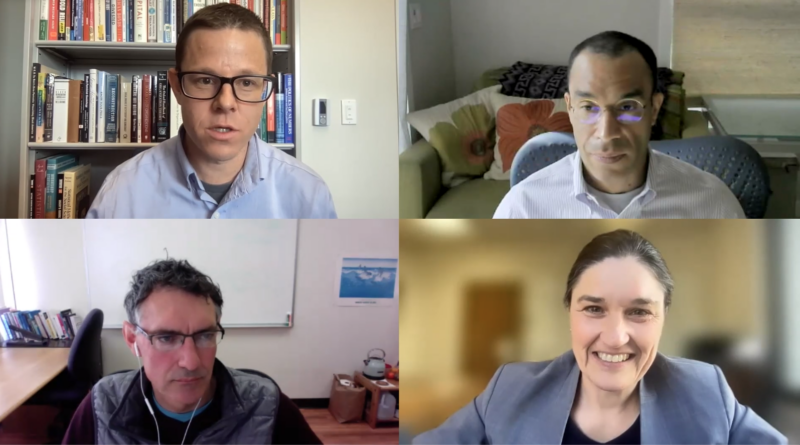 In his remarks, Professor Jonathan Glater agreed that “it is difficult to overstate the corrosive effects of money in the financing of higher education.” Beyond student debt, Glater said, the influence of money in higher education affects credentialing of institutions, as well as the admissions and grading of students, “because students are not paying for C’s, D’s, and F’s, they’re paying for A’s.” It also leads to “inequity of opportunity in the form of increasing student debt, which not only may discourage students, but slows the possibility of socioeconomic advancement for students after they graduate.”